jueves, 16 de octubre de 2014

Pale Blue Dot

PaleBlueDot

 The Pale Blue Dot is a photograph of planet Earth taken in 1990 by the Voyager 1 spacecraft from a record distance of about 6 billion kilometers from Earth, as part of the solar system Family Portrait series of images. In the photograph, Earth is shown as a tiny dot (0.12 pixel in size) against the vastness of space. The Voyager 1 spacecraft, which had completed its primary mission and was leaving the Solar System, was commanded by NASA to turn its camera around and to take a photograph of Earth across a great expanse of space, at the request of Carl Sagan.

This is an animated version of Carl Sagan's famous audio-text about The Earth, pale blue dot

https://www.youtube.com/watch?v=nl5dlbCh8lY&feature=youtube_gdata_player

miércoles, 30 de abril de 2014

Water cycle


Several TV series and programs help us to study by showing or demonstrating some science processes. For example Bill Nye, the Science Guy and The Magic School Bus. You may consider this last one for kids but try and enjoy it.

Take a look at these videos or listen to the song. You can review the water cycle with them. You will learn stages and processes of the water cycle. Or you can have a summary of water by ticking here.


jueves, 30 de enero de 2014

DNA

Deoxyribonucleic acid (DNA) is the molecule that contains the genetic instructions of all known living things.

Here I leave an animated movie and related topics about DNA in order to learn about it.


miércoles, 15 de enero de 2014

3D anatomical model

By this application you will study and review human anatomy. It is a 3D anatomical model showing different layers of the human body.


sábado, 30 de noviembre de 2013

The man who bottled evolution

Evolution is a slow process that cannot be seen in real time. So evidences of evolution are always searched backward in time, using the fossil record, genetics or biochemistry of living things today, but it cannot be studied forward (we never know how species are going to change).


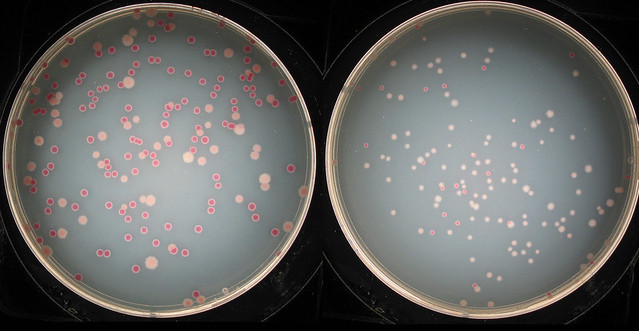
Plates with bacteria culture
In 1988, at the Michigan State University, an experiment started with bacteria. Richard Lenski and his research group began to grow 12 populations of Escherichia coli and by reproducing and caring them day and night they have completed over 58.000 generations(equivalent to 1 million years in humans).
The conclusion in this experiment, which has been operating for over 25 years, is evolution never stops, even when the conditions of life do not change.

I leave several links to the news

Experiment data.  Science

References: Fogonazos

martes, 26 de noviembre de 2013

Darwin on the evolution trail

This video summarizes Darwin's life, from his early youth as a collector of insects through the 5 years trip on the HMS Beagle until he published his book "On the origin of species by means of Natural Selection". We can see how he was shaping and maturing his shocking and revolutionary idea of evolution and the difficulties he encountered .... even in his own wife ("I don't like your ideas, Charles!")


Reference: Evolution of life